From intended purpose to CE mark — the whole route.
Regulatory Sidekick is a stepwise implementation of the entire regulatory journey for placing a device on the EU market — set out in four phases, scoped to your device. The ISO 13485 quality system is part of the route, not the whole of it. Made for manufacturers, by manufacturers.
This site explains the regulation. Sidekick walks you through it.
The navigator, wizards and courses here answer what does the regulation say? Regulatory Sidekick answers the next question — what do I actually do on Monday morning? — as 116 sequenced activities scoped to your device, each with its templates, records and clause coverage attached.
Four phases, research bench to market.
Compliance follows product maturity. Research isn't regulated development — so the plan starts lean and tightens as your device becomes real.
Set the foundations
Stand up a lean quality system and define the product. Full design controls don't apply yet — settle the gates that let development start.
- Intended purpose
- Qualification & classification
- Lean QMS core
- Roles, documents & suppliers
Develop under control
The design and development heavy-lift. Write the plans, build the device, and run the initial analyses that generate your evidence.
- Design & development plans
- Risk management
- Software, cyber & usability
- Clinical / performance plans
Verify, validate & make
Prove the device works and that you can build it repeatably — then run the quality system for real.
- Design & software V&V
- Clinical, performance & usability evidence
- Production & sterilization
- CAPA, complaints & nonconformity
Certify, launch & operate
Compile the dossier, pass the assessment, carry the mark — then keep it valid once the device is on the market.
- Technical file & DoC
- Notified Body & CE mark
- Post-market surveillance & vigilance
- Internal audit & management review
Not a folder of templates. A system you operate.
Every view below is scoped to one device profile — here, in vitro diagnostic software under the IVDR. Choose a different profile and the plan changes with it.
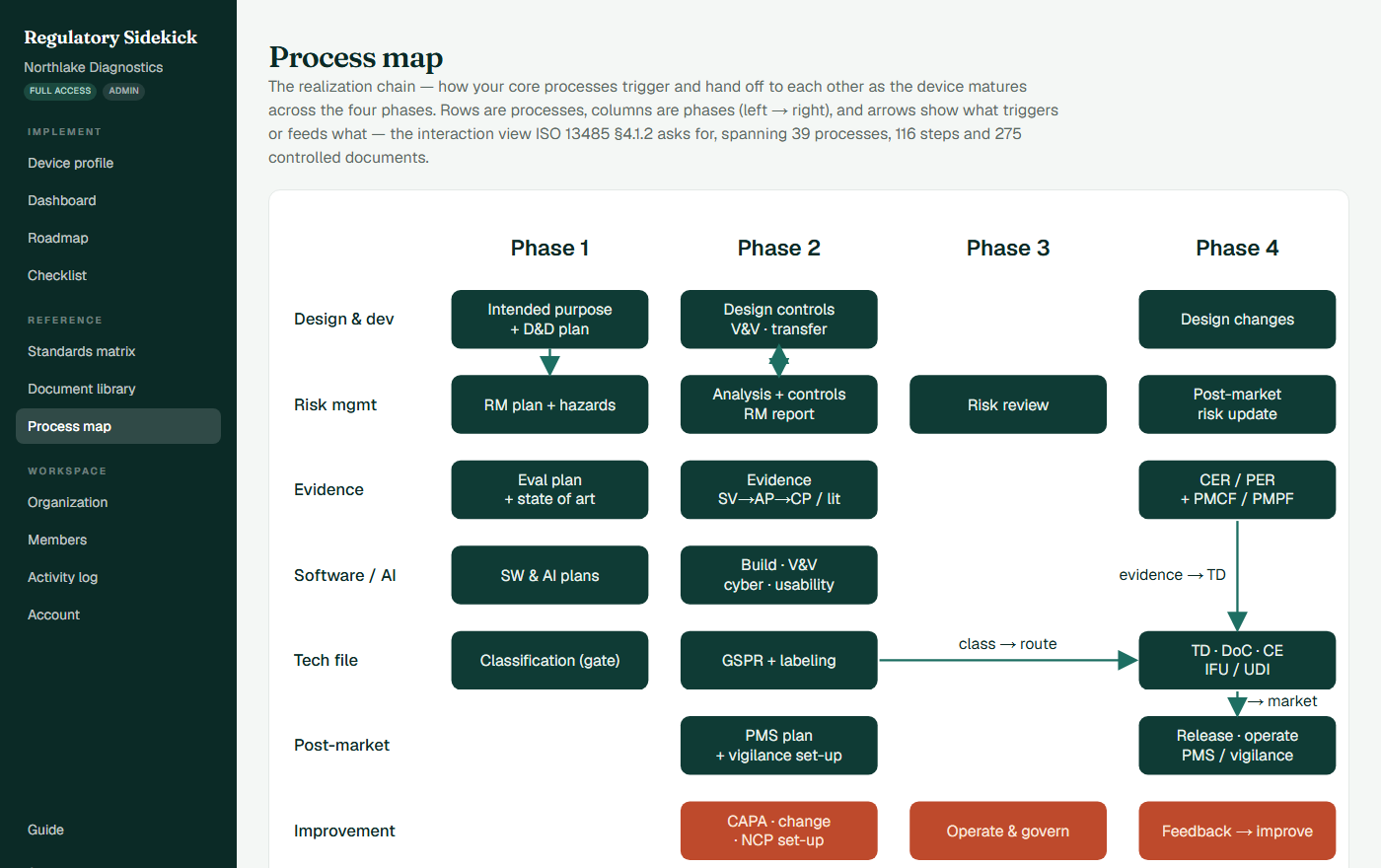
The realization chain — how your processes trigger and hand off to each other across the four phases. The interaction view ISO 13485 §4.1.2 asks for.
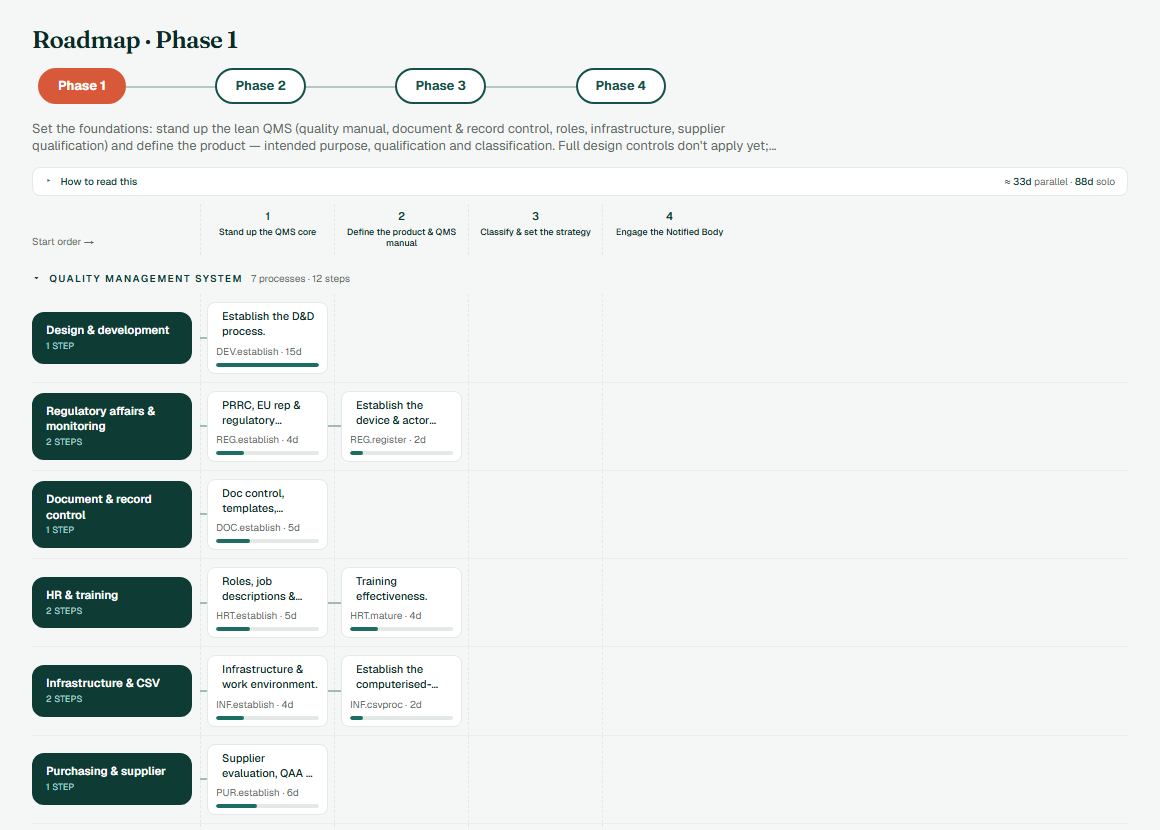
Know what to start today.
Rows are processes, columns are start order. Each activity sits in the column where its inputs finally exist — so you never open a step whose prerequisites haven't been written yet. Gaps in a lane are meaningful, not missing.
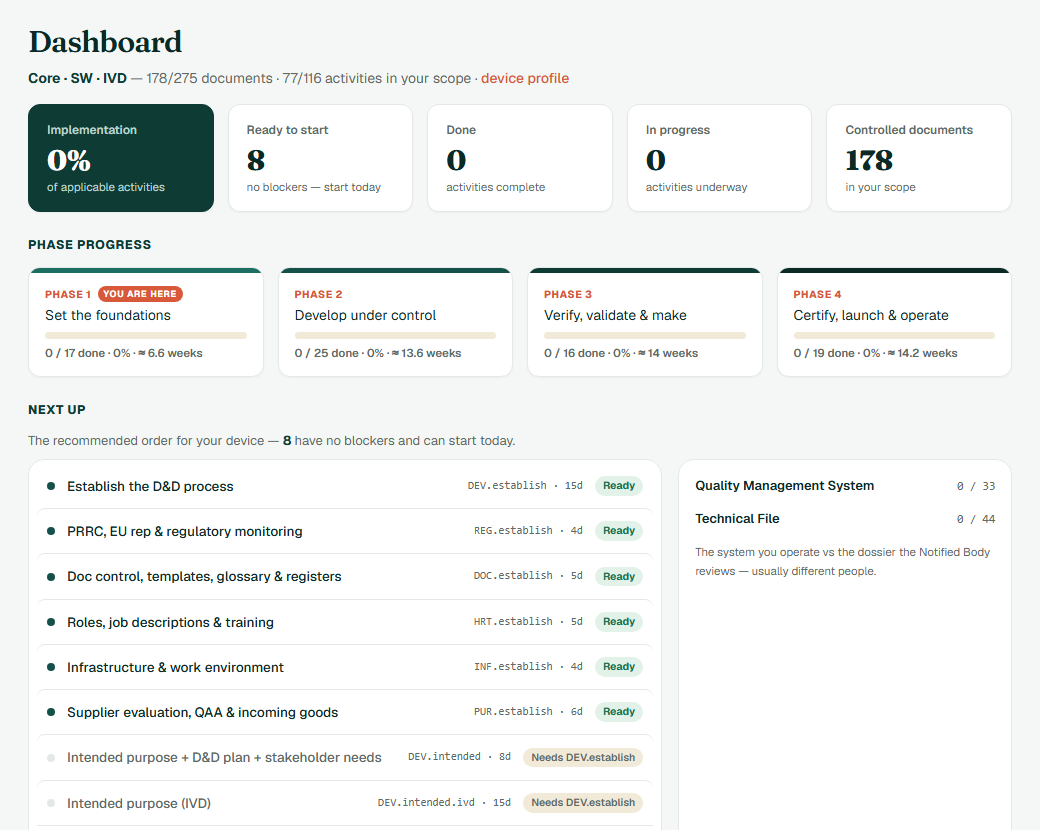
See the whole build at a glance.
Progress across the four phases, what's ready to start with no blockers, and how many of the 275 controlled documents are in your scope. This device profile draws 178 of them — the rest never appear.
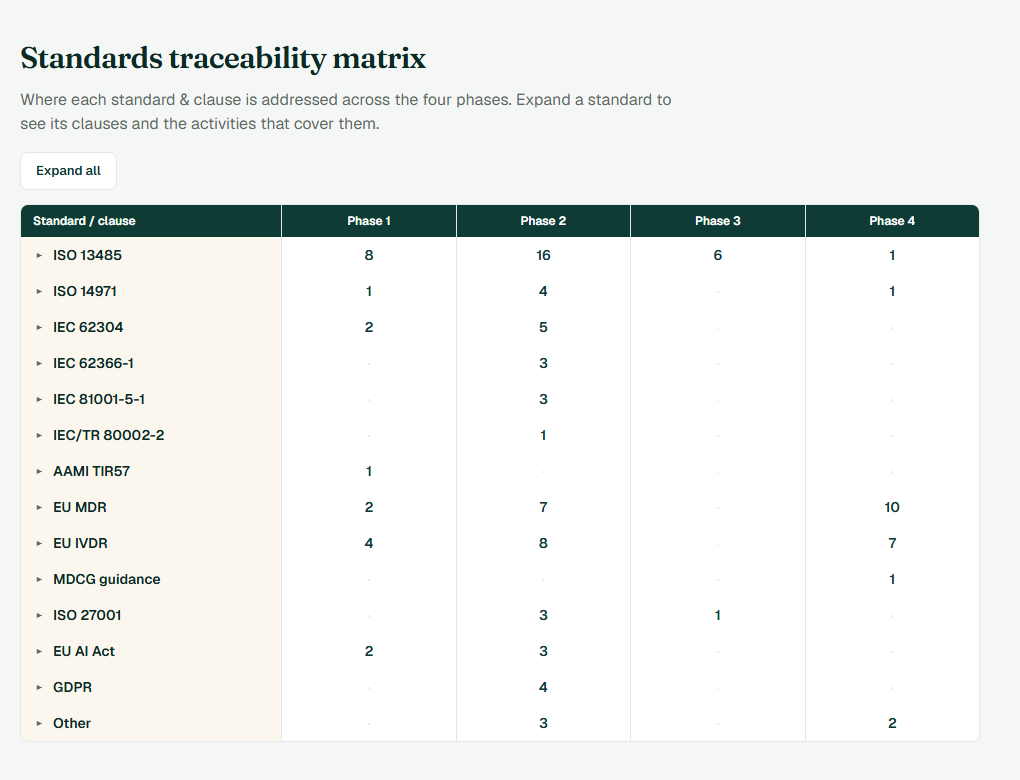
Show the auditor the coverage.
Every standard and clause you're claiming, mapped to the activities that address it across the four phases — ISO 13485, ISO 14971, IEC 62304, IEC 62366-1, the MDR and IVDR themselves, and more.
An IVD should never be shown clinical evaluation.
Pick your EU route — MDR or IVDR — and your device characteristics: software, AI, sterile, implantable, and whether you're also going to the FDA. The plan, the templates and the clause coverage all follow. The screenshots above show 77 of 116 activities and 178 of 275 documents, because that's what IVD software under the IVDR actually needs.
Explore it free. Unlock when you're ready.
Browse the phases, the process map and a sample activity without paying. Unlock the full plan and all 275 templates when you're ready to build.
Start-ups taking a first device to the EU market, and small manufacturers who need a route to CE without a consultant on retainer.